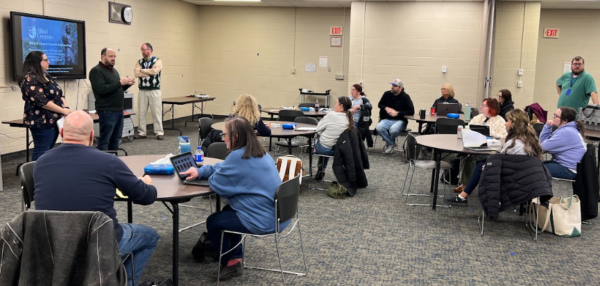
Educators are introduced to the hands-on activities by Alfred University’s Department of Engineering.
The Ceramic and Glass Industry Foundation (CGIF) recently collaborated with Alfred University’s department of engineering to bring materials science classroom activities to educators in Belmont, New York through a professional development workshop hosted by the New York Board of Cooperative Educational Services (BOCES). Led by CGIF Program Manager Nathan McIlwaine, the session introduced 11 elementary and middle school science teachers to hands-on lessons from CGIF’s Mini Materials Science Kits and online lesson resources designed to make complex science concepts accessible across the K–12 level.
The workshop was organized in collaboration with Professor Benjamin Moulton, Outreach Coordinator Amelia Overbye, and student volunteer Grace Dunham, a PhD candidate in Ceramic Engineering. These volunteers presented on the background of materials science, glass, and ceramic engineering, helping connect CGIF outreach resources with clear pathways students can pursue after high school, from university programs like Alfred to careers in the field. Belmont sits within a unique corridor of materials innovation, positioned between Rochester’s photonics industry, Corning’s global leadership in glass manufacturing, and the long-standing ceramics manufacturing presence in Buffalo and throughout New York State. Supporting STEM outreach in this region, with a leading ceramics and glass science university just down the road, helps connect classrooms directly to the industries shaping the local economy.
Rather than simply observing demonstrations, teachers practiced facilitating the lessons themselves using activities from CGIF’s Mini Materials Science Classroom Kit and online resources. These lessons are designed specifically for K–12 educators to bring interactive materials science learning into their classrooms. The kits introduce students to foundational concepts in ceramics, metals, polymers, composites, and glass through experiments aligned with core STEM standards.
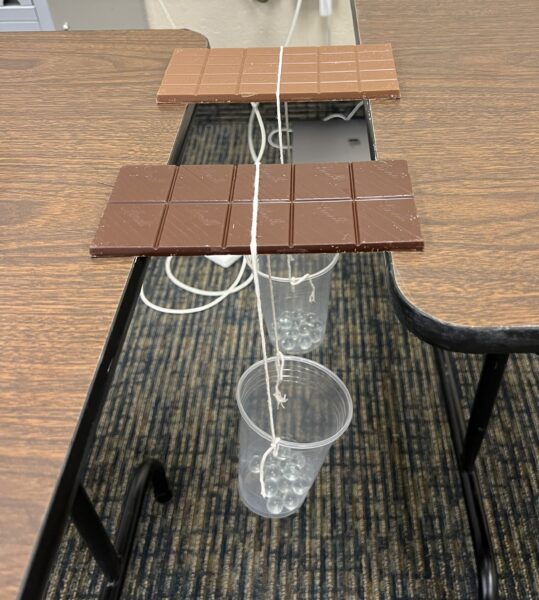
Materials set up for the How Strong Is Your Chocolate? activity.
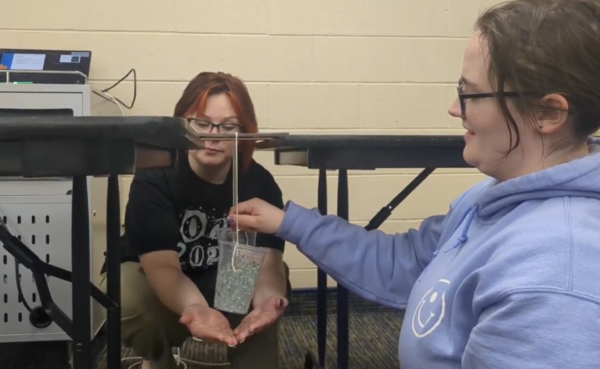
Educators testing chocolate strength during the How Strong Is Your Chocolate? activity.
One of the most popular activities was How Strong Is Your Chocolate?, a lab-based lesson that explores how material structure and processing affect strength. Teachers tested and compared samples while discussing how engineers evaluate material properties, processing, and performance. As one teacher, Jillian Filbert from Wellsville Central School, shared afterward, “The chocolate experiment was super easy and super fun.”
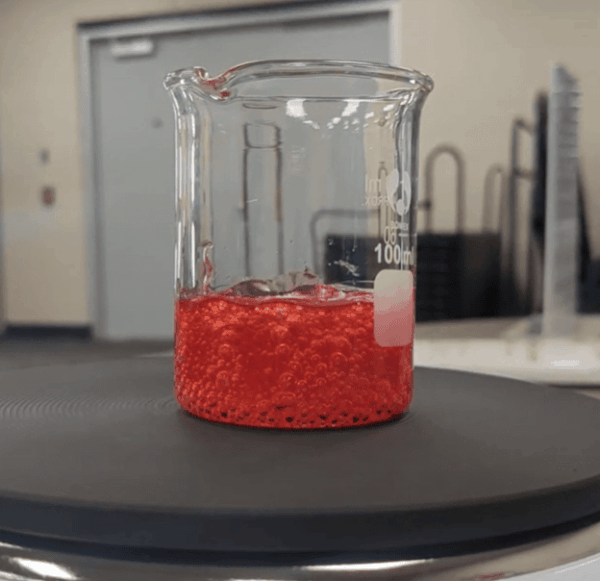
Jolly Ranchers melting in a beaker for the Candy Fiber Pull activity.
Participants also explored the Candy Fiber Pull activity from the Mini Materials Kit, which uses simple materials to demonstrate deformation and materials behavior, making it especially useful for classrooms with limited lab equipment. Teachers repeatedly highlighted how engaging the hands-on participation activities were, particularly demonstrations like the candy fiber pull that allow students to see and feel materials behavior in action.
Another highlight was the Nitinol wire lesson, which introduces students to shape memory alloys and phase transformations. Although not included in every kit, the lesson demonstrated how CGIF trainings can expand teacher familiarity with additional materials science concepts that connect chemistry, physics, and engineering.
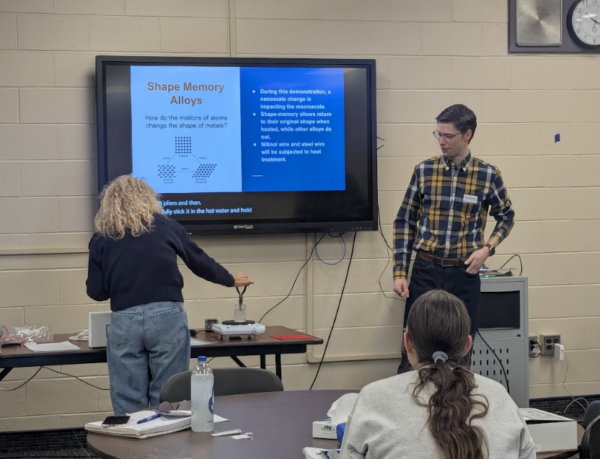
An educator volunteers for the Nitinol wire activity alongside CGIF Program Manager Nathan McIlwaine.
Throughout the workshop, teachers also discussed practical strategies for adapting activities across grade levels, integrating lessons into existing units, and connecting experiments to science standards. One participant, Michelle Sullivan, an elementary STEAM teacher from Prospect Elementary School, said her favorite part of the workshop was “seeing all of the great lessons that I can bring back and use with my students.”
CGIF’s teacher trainings are part of a broader suite of Teacher Resources that include free lesson plans, video demonstrations, and opportunities for educators to request classroom science kits. These resources help teachers bring materials science concepts, from slip casting and thermal processing to mechanical testing and composites, into everyday instruction.
By equipping educators with both the tools and confidence to teach materials science, CGIF expands access to hands-on STEM learning while supporting teachers in their ongoing professional growth. As these 11 educators return to their classrooms ready to implement new lessons and spark curiosity, hundreds of students will soon explore the science behind the materials that shape our world.
Help us continue to empower the next generation of ceramic and glass professionals. Give now at https://foundation.ceramics.org/get-involved/donate/