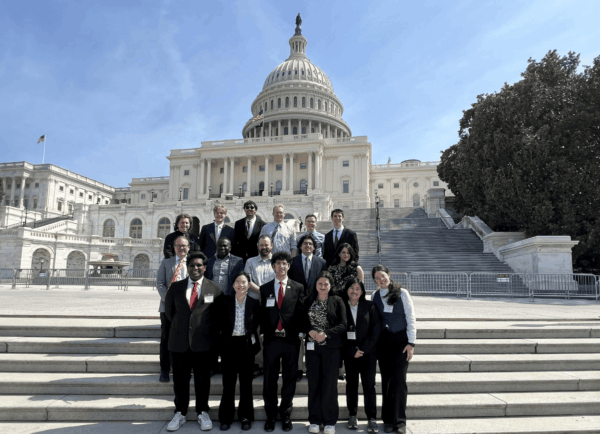
Students and faculty advisor Professor Patrick Johnson gather outside the U.S. Capitol during Congressional Visits Day on March 26, 2026.
Each spring while Congress is in session, Material Advantage brings students studying materials science and engineering (MSE) to Washington, D.C. for Congressional Visits Day (CVD), an opportunity to step out of the lab and classroom and into the offices of the people who shape federal science policy. The 2026 event brought together 38 undergraduate and graduate students for two days of advocacy, professional development, and peer engagement. As Eric Lin, an undergraduate student studying MSE at Carnegie Mellon University, put it, “It was a great experience walking into the Senate and House buildings and talking directly to the staffers to advocate for materials science.”
Program Manager, Dr. Nathan McIlwaine, of the Ceramic and Glass Industry Foundation, was onsite organizing the program throughout the event. The evening of March 25 began with a reception and training session that set the tone for the visits ahead. Three faculty advisors from the Material Advantage community volunteered their expertise to prepare students for the experience. Dr. Megan Malara, Innovation Hub Director at the National Center for Defense Manufacturing and Machining, brought a dual perspective to the program as a former AAAS Congressional Science and Technology Policy Fellow. Professor Patrick Johnson of Iowa State University and Professor Michael Titus of Purdue University contributed their depth of experience in materials research, each advisor contributing to the months of preparation that helped ensure students arrived ready.
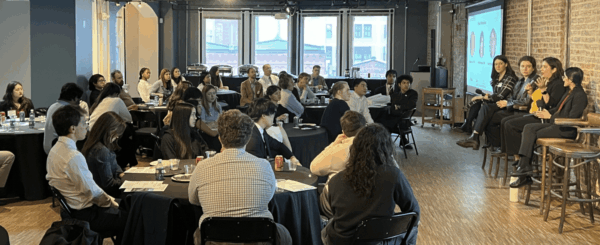
AAAS Congressional Fellows serve as panelists during the welcome reception, sharing insights into the role of congressional staff and science policy engagement ahead of Capitol Hill visits.
Dr. Alessandra Zimmerman, Senior Manager of Research and Development Policy at AAAS, delivered a presentation on the federal budget process, giving students a clear overview of how funding decisions are made, where science and engineering fit within federal R&D priorities, and how advocates can engage effectively with policymakers. A panel of three AAAS Congressional Fellows, Dr. Rachael Lau, Dr. Rubi Gonzales, and Dr. Swati Narasimhan, moderated by Dr. Malara, added practical grounding to that foundation. Each had completed advanced degrees in scientific fields before transitioning into roles supporting members of Congress, and their accounts offered students a grounded perspective on what science advocacy looks like in practice.
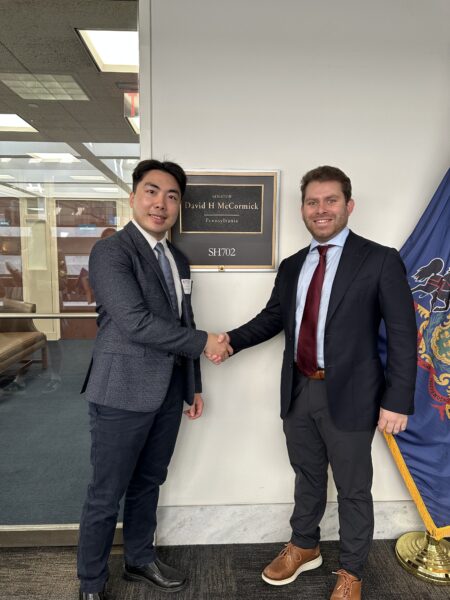
Eric Lin meets with staff from Senator David H. McCormick’s office following their discussion on materials science and federal R&D.
On March 26, students carried those conversations onto Capitol Hill. Coordinating where possible with peers from the same state or congressional district, they met with legislative offices throughout the day, drawing on their academic experiences to make the case for federal investment in materials science and engineering. Their visits came at a meaningful moment, with congressional offices in the early stages of the fiscal year 2027 budget process. The conversations were substantive. As Eric Lin reflected in one discussion, students were able to connect fundamental limits in semiconductor technology with the need for sustained U.S. investment in research and manufacturing, reinforcing the role of federal support in maintaining global competitiveness. Washington in late March added to the experience, with cherry blossoms in bloom and warm, sunny weather making for a memorable day.
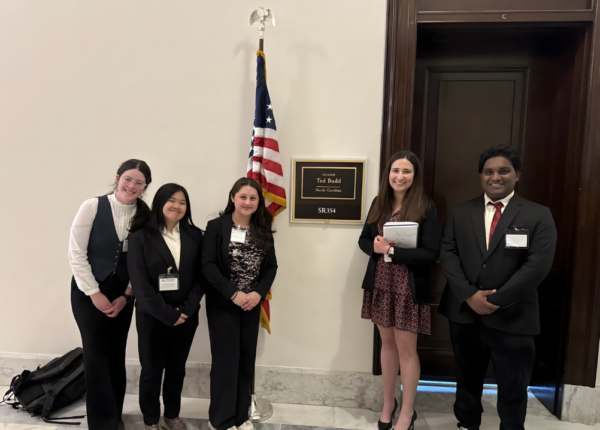
Undergraduate students from North Carolina State University meet with staff from Senator Ted Budd’s office. Left to right: Adriana Lara, Ariel Diem Nguyen, Cordelia McKelvy, and Aaron Thomas.
The experience extended well beyond the policy discussions themselves. As Hossein Libre, an MSE student at Missouri University of Science and Technology, shared: “Congressional Visits Day opened up a whole new world for me. It changed how I think about the broader impact of technical work and how researchers can engage with policy. Seeing people with backgrounds similar to mine working on the Hill made me realize this path could be for me too.”
The Ceramic and Glass Industry Foundation extends its sincere thanks to the students who represented their institutions and the broader materials community with enthusiasm and distinction. Material Advantage is a collaborative program of four professional societies: ACerS, AIST, ASM International, and TMS. Events like Congressional Visits Day represent a shared investment in the future of the field and in ensuring the materials community has a voice in decisions that shape scientific research in this country.
Help us continue to empower the next generation of ceramic and glass professionals. Give now at https://foundation.ceramics.org/get-involved/donate/