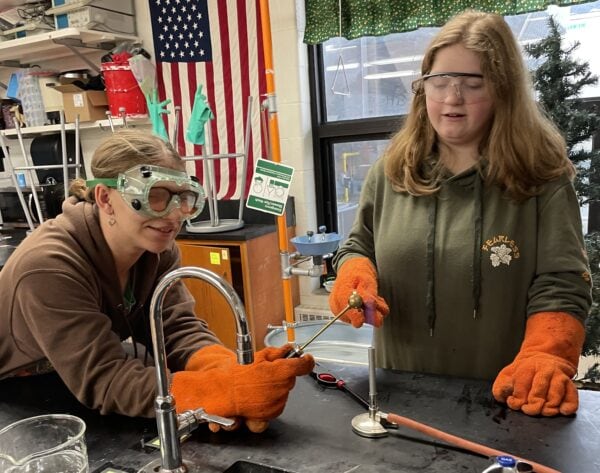
Two students at South Shelby High School experimenting with a Bunsen burner.
For students at South Shelby High School, a small rural public high school in northeast Missouri, materials science recently moved from an unfamiliar term to a hands-on, eye-opening experience. With support from the Ceramic and Glass Industry Foundation (CGIF), a hands-on classroom project introduced more than 100 students to materials science concepts through experiments that connected chemistry, engineering, and everyday life.
The project reached 42 Chemistry and Conceptual Chemistry students and 58 Physical Science students, using CGIF Material Science Kits to bring materials science directly into required coursework. For many students, this was their first exposure to materials science as a discipline, and for some, it sparked a new sense of possibility.
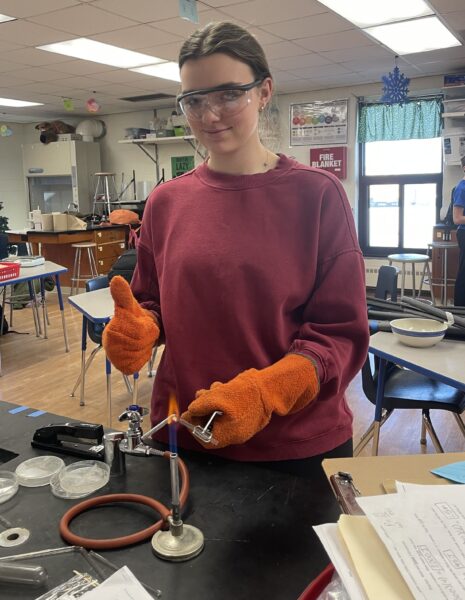
A student heats a steel bobby pin as part of the Thermal Processing lesson in the Materials Science Classroom Kit, exploring how heat affects materials.
Rather than adding extra content to an already full curriculum, materials science lessons were intentionally embedded into existing chemistry and physical science units. Short, focused activities, many completed in under 30 minutes, allowed students to explore materials behavior during units on chemical reactions and thermochemistry. Each activity concluded with discussions about how the concepts are applied in real-world industries and careers, helping students connect classroom science to potential future professions.
The hands-on nature of the project proved especially impactful. Students bent and fused glass, created magnets, and designed glass jewelry, gaining firsthand experience with materials processing. One of the most popular activities was the Engineering Concrete experiment, where students designed reinforced concrete pucks and tested them under extreme conditions, including drop tests, impact tests, and compression from a rolling tire.
Students enthusiastically refined their designs, often researching reinforcement strategies outside of class. One student who typically struggled with engagement became deeply invested in the challenge. His design outperformed others in two of the three tests, and he confidently explained the science behind his success to classmates.
“The students rallied around him,” recalled Lisa Stevenson, the high school science teacher. “He had learned the major concepts and applied them in a meaningful way.”
Materials science also helped students reinterpret familiar experiences in their community. Many attend a local festival where blacksmiths demonstrate traditional metalworking techniques. After completing a thermal processing activity using simple bobby pins, students began making connections between atomic-level changes and blacksmithing practices.
“So many light bulbs came on,” the teacher shared. “They realized that what they were seeing at the festival was the same science happening at the atomic level.”
These connections fueled new interests among students, including welding, bladesmithing, and materials processing, fields closely tied to both industry and craftsmanship.
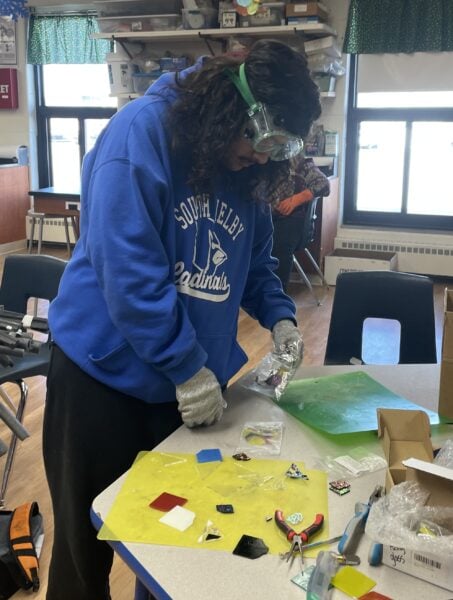
A student gathers materials in preparation for an experiment.
Perhaps most significantly, the project introduced students to materials science as a career path. While many were familiar with civil and mechanical engineering, materials science was largely unknown. Exposure through hands-on learning changed that perception.
“This would be such a cool job,” one student said. “You get to test and design new stuff that helps people.”
Another student, preparing to begin college in engineering, has since chosen to take a materials science elective and is considering making it his major.
In a region where agriculture is a primary livelihood, not every student will become an engineer, but every student benefits from understanding how materials shape the tools, technologies, and products that support their lives. By bringing materials science into the classroom, with CGIF’s support, this project empowered students to think critically about the world around them and imagine how science and engineering can help solve real-world problems.
Help us continue to empower the next generation of ceramic and glass professionals. Give now at https://foundation.ceramics.org/get-involved/donate/