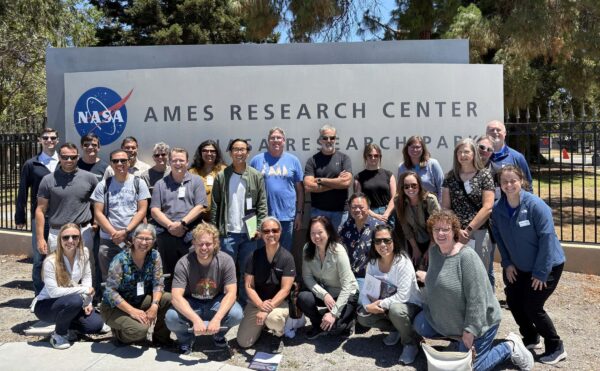
Group photo of the tour attendees, volunteers, and CGIF staff at the NASA Ames Arc Jet Facility Tour.
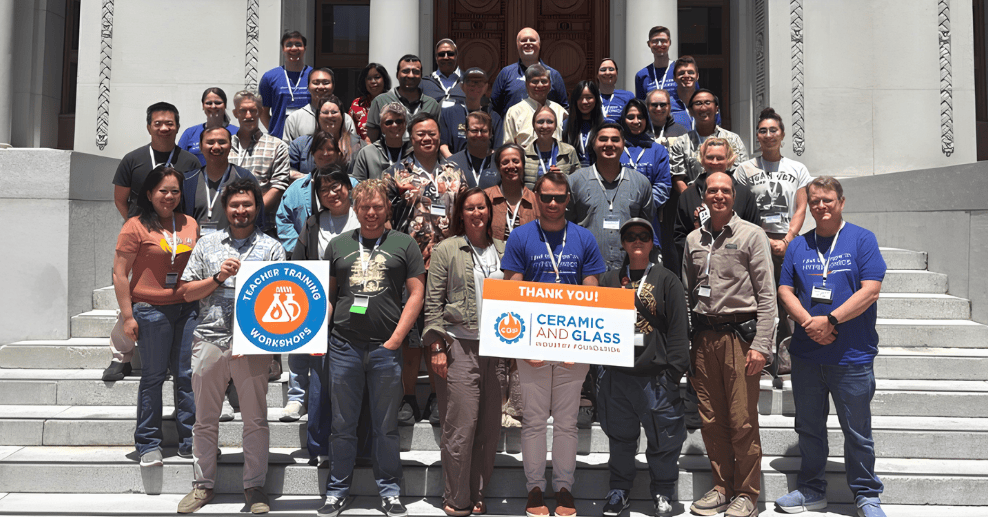
The Ceramic and Glass Industry Foundation (CGIF) welcomed teachers from a variety of educational settings to NASA Ames Research Center in Moffett Field, California, on Thursday, June 25, for a hands-on tour of the Arc Jet Complex, one of the most powerful hypersonic materials testing facilities in the world. Participants included homeschool, preschool, elementary, middle, and high school educators. The tour closed out a week of Northern California programming that began two days earlier with CGIF’s Magic of Materials Teacher Training Workshop at UC Berkeley, giving teachers from the surrounding Bay-area the opportunity to see the concepts from the classroom brought to life at national-laboratory scale in their own backyard.
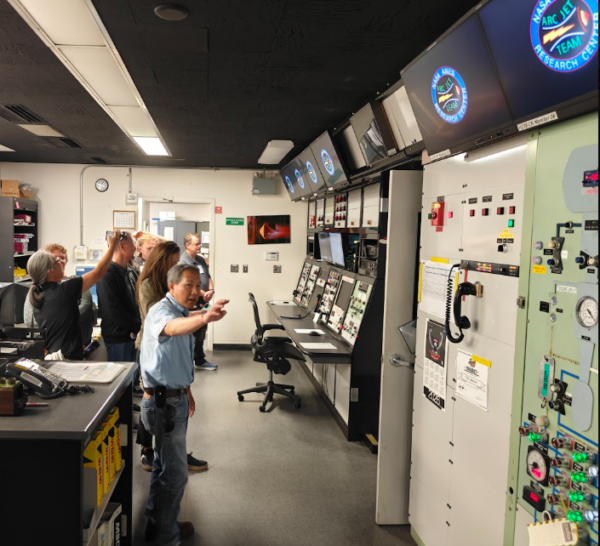
Inside the Arc Jet Facility control room with Frank Hui, test engineer.
Sid Sun, NASA Ames’ Lead for University Collaborations, led the visit alongside Mairead Stackpoole, Chief of the Thermal Protection Materials Branch, and branch researcher Peter Marshall. The team introduced teachers to the science behind thermal protection systems, explaining how these specialized materials are designed and tested to withstand the extraordinary heat of hypersonic flight and atmospheric reentry from outer space. They then put that science directly into teachers’ hands, passing around actual test specimens of the materials they had just discussed, designed for actual NASA missions.
From there, Frank Hui, Enrique Cabillero, and Scott Eddlemon, experts responsible for operating the arc jets, guided small groups of teachers through the Arc Jet Complex itself, where they viewed the 20-megawatt and 60-megawatt arc jets up close. The 60-megawatt unit, NASA’s Interaction Heating Facility, is the largest arc jet in the NASA system and among the most powerful in the world, capable of drawing as much power as a small city. The arc jets generate concentrated streams of superheated, partially ionized gas that recreate the intense aerodynamic heating experienced during hypersonic flight and atmospheric entry. The 60-megawatt system can also use high-powered lasers to add intense radiant heating directly to test specimens, allowing researchers to study how advanced materials perform under some of the most extreme conditions encountered in aerospace applications.
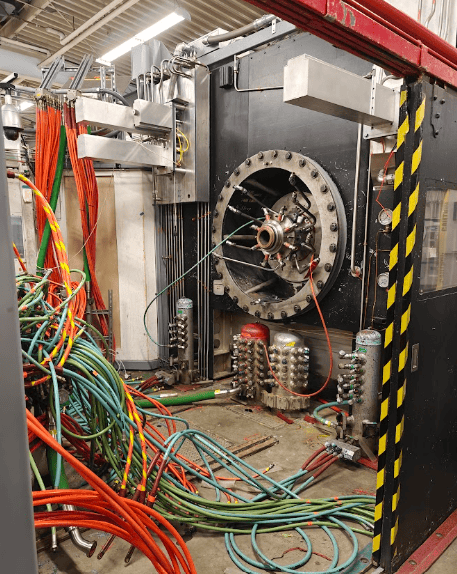
A view of the arc heater that creates the plasma for the arc jet.
Teachers left the day with a sense of the incredible demands placed upon materials selected for hypersonic flight, and the great lengths taken by NASA engineers to simulate those environments. “The entire experience was amazing! Aside from viewing the arc jet, the enthusiasm from the NASA presenters as they explained their life’s work was inspiring,” said Erin Hall, a middle school science teacher at Mill Valley Middle School. “They were so proud to share information and answer questions about previous and current missions.”
Getting to hold and examine real materials made the science tangible. “[My favorite part of the tour was] being able to hold an insulation tile and see the laser set up with the examples of melted materials caused by the laser,” said Elaine Wong, an elementary science teacher at Cornell Elementary in Albany, CA. For Garland Dughi, simply walking the grounds brought the applications into focus: “Walking around the ARC facility and hearing about how this enables space technology was awesome.”
Following the tour, teachers reported a significant boost in their understanding of how materials science applies to aerospace and hypersonic research, thanks in large part to the direct access to NASA scientists and staff, whose visible passion for their work stood out as a highlight of the day.
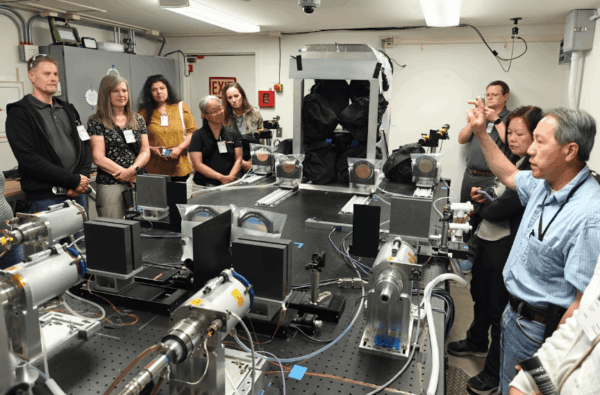
Frank Hui, test engineer, brings teachers into the laser room, where high-powered lasers are aligned to test samples in the adjoining arc jet tunnel for even higher temperatures.
Each participant left with a gift bag featuring CGIF materials science resources and T-shirts to wear in their classrooms, and every attendee is receiving a complimentary Materials Science Classroom Kit to bring hands-on activities directly into their classrooms this fall.
As these teachers return to their classrooms, they carry with them a firsthand look at the cutting edge of materials science, ready to help students imagine their own place in the future of space exploration.
CGIF extends a heartfelt thank you to NASA Ames Research Center for hosting, and to Sid Sun, Mairead Stackpoole, and the entire Arc Jet Complex team for sharing their expertise and enthusiasm with educators.
Help us continue to empower the next generation of ceramic and glass professionals. Give now at foundation.ceramics.org/get-involved/donate