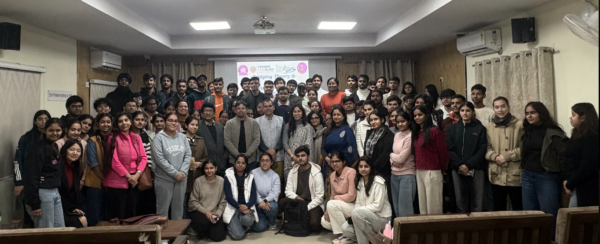
Participants in Dr. Yadav’s “Bridging Theory and Practice: A 10-Day Immersive Course in Materials Science” project.
The University of Delhi enrolls more than 40,000 undergraduate science students across over 40 affiliated colleges, yet it offers no dedicated undergraduate program in materials science. Students may encounter related ideas in physics and chemistry courses, but many never learn that materials science is a field of its own. With support from the Ceramic and Glass Industry Foundation (CGIF) through its project grant program, Dr. Anupama Yadav, Assistant Professor of Physics at Sri Aurobindo College, set out to change that with a 10-session immersive course in materials science, held over four months.
The program was designed for 50 students. Instead, 279 students from 22 colleges applied. Given the strong response, the team expanded the cohort to 80 participants, with Sri Aurobindo College contributing additional funding to make room for the larger group.
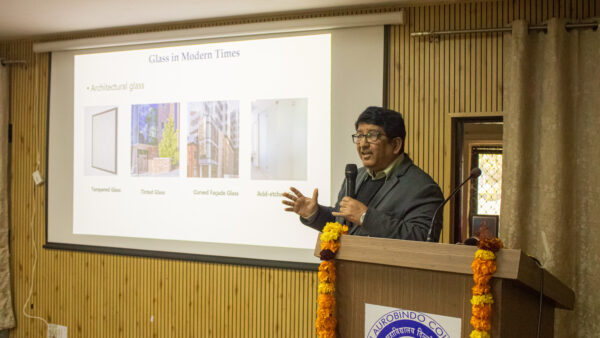
Speaker Prof. Ramesh Karuppannan of the Department of Physics at the Indian Institute of Science (IISc), Bangalore, presenting his lecture, “Glasses: Materials That Built Modern Science and Society.”
Between January and April 2026, students attended 16 lectures from scientists and faculty at institutions across India and abroad, with glass and ceramics at the center of the program. Speakers explored topics such as using AI to accelerate glass discovery, the rheology of inorganic glasses, advanced ceramics for nuclear energy, and turning nuclear waste into glass. Students also gained hands-on experience at two of India’s advanced research laboratories, both in Delhi. At the University Science Instrumentation Centre (USIC) at the University of Delhi, they trained on a scanning electron microscope (SEM), an X-ray diffractometer (XRD), and a Raman spectrometer. They also visited the Solid State Physics Laboratory (SSPL), one of India’s national defense research laboratories.
“I learned a lot of new things and gained valuable hands-on experience that standard textbooks miss,” one student shared. Another wrote that the course “helped me discover the whole new dimension of ceramics and material sciences which I wasn’t that much aware of before.”
The program concluded with a poster competition, where many students presented research for the first time, and a session with Master’s and PhD scholars who shared their paths into graduate study. “Preparing and presenting a poster boosted my confidence and improved my communication skills,” one student said.
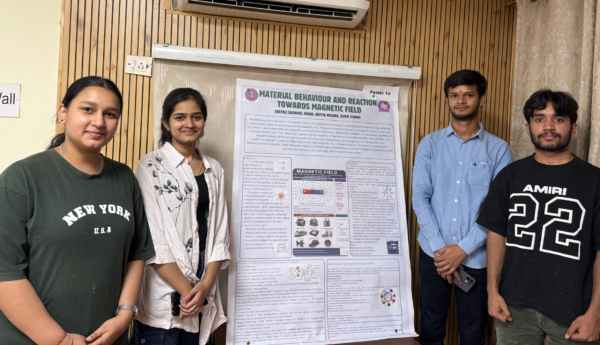
Students standing alongside their posters during the poster presentation competition held at the conclusion of the program.
The most meaningful outcomes came after the final session. Parv Shah and Anivesh Singh of Motilal Nehru College completed three-month summer internships at the Indian Institute of Science (IISc) under Prof. Ramesh Karuppannan, one of the program’s invited speakers. Three more students completed internships at SSPL after meeting scientists during the lab visit, and several others joined research labs at the University of Delhi and Sri Aurobindo College. For students like Parv, these experiences can shape an entire career. Just months after the course ended, he is writing his first research paper as lead author. His introduction to ceramic and glass materials through this program gave him a starting point in the field, and he is already building on it as a researcher.
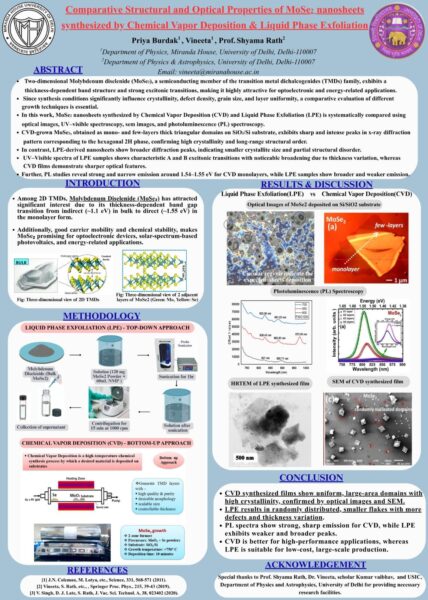
The “Best Poster” from the poster presentation competition, comparing molybdenum diselenide nanosheets produced by chemical vapor deposition and liquid-phase exfoliation, with a focus on their structural and optical properties.
“One of the most valuable outcomes was connecting with Dr. K. Ramesh, which eventually led to a summer internship at IISc, where I am gaining hands-on experience in the synthesis and characterization of chalcogenide glasses,” one intern wrote.
Survey results showed the same enthusiasm. Every respondent rated the course as good or excellent, with 77% choosing excellent, and nearly 63% said the course stimulated their interest in further study or research in materials science to a great extent.
Building on this success, Dr. Yadav hopes to establish the course as an annual program at the University of Delhi, creating more pathways for undergraduates into materials research. What began as a plan for 50 students became a gateway into materials science for 80, and a first research experience for several of them. CGIF is proud to have supported this program and the next generation of ceramic and glass scientists it is helping to launch.
Help us continue to empower the next generation of ceramic and glass professionals. Give now at https://foundation.ceramics.org/get-involved/donate/